Thai Ha Books
Friday, 5 June 2026
Dr Nguyen Manh Hung has loved books since he was a young child. That love accompanied him throughout his years at a French-specialist secondary school in Hanoi, during more than twelve years of study and work in the Soviet Union and Russia, and throughout his career at FPT. It grew even deeper when he founded Thai Ha Books in 2007.
After more than 40 years of reading, nearly 20 years of publishing, and countless years devoted to books and the promotion of reading culture, he has come to realise an increasingly profound truth: books are far more than mere products. Books are knowledge. Books are culture. Books are history. And above all, books are among the most important means through which human beings can develop and fulfil their potential.
Many people have asked Dr Nguyen Manh Hung whether books still have a future in the age of artificial intelligence, social media and short-form videos. His answer has always been the same: as long as people continue to seek knowledge, personal growth and a better quality of life, books will always have a future.
Yet for books to remain faithful companions in people’s lives, those working in publishing must never cease to innovate. The journey undertaken by Dr Nguyen Manh Hung and Thai Ha Books over the years, marked by immense effort, perseverance and intellectual dedication, has been a continuous search for new ways to bring knowledge closer to readers. From special editions and pocket books to miniature books, every initiative springs from the same love of books and the same conviction that knowledge deserves to be shared in many different forms.
He has often confided in us that some books are created to be read, while others are created to be treasured and passed down through generations. Many years ago, he and his colleagues began producing special editions with the ambition of elevating books into works of cultural and artistic significance.
These books are crafted from an extraordinary variety of materials. Some are coated with multiple layers of lacquer using traditional Vietnamese techniques. Others feature entirely handcrafted mother-of-pearl inlay. Some are embroidered by hand on silk, while others are bound in brocade. Certain editions incorporate truc chi, a distinctive Vietnamese form of paper art. Others are crafted from bronze, made using lotus leaves, or embellished with gold detailing and other precious materials.
Every book represents dozens of hours of meticulous craftsmanship by artisans, artists, designers and publishing professionals.
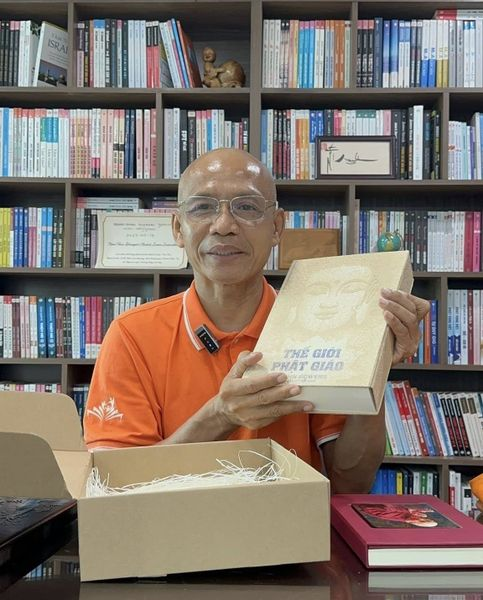
When people see these books, he often tells them that they are works of art rather than simply books. He holds each volume tenderly in his hands, spending hours not only reading it but also admiring its beauty.
I met him as he sat surrounded by 39 special-edition titles that had already been published, speaking with great enthusiasm about the fortieth, which was still being crafted. As I listened, I felt a deep sense of joy. I could see and feel the extraordinary love and passion he has for books.
I understood the sentiment behind his words: the aim is not merely to create a beautiful object, but to honour the value of knowledge itself. A good book can change a life. A beautiful book can be cherished for generations. He has always believed that when people learn to treasure books, they also learn to treasure the knowledge contained within them.
Modern life, however, presents a new challenge. Through careful research and close observation, he has recognised that people are becoming increasingly busy. Young people spend more time looking at their phones than turning the pages of books. Many have told him that they would love to read but simply cannot find the time. This troubled him deeply. He kept asking himself how knowledge could accompany the rhythms of modern life. How could someone read on a bus, on the underground, during a lunch break or while waiting for an appointment?
From these reflections, Dr Nguyen Manh Hung and his colleagues developed a range of pocket-sized books. Alongside internationally renowned classics such as How to Win Friends and Influence People, How to Stop Worrying and Start Living and As a Man Thinketh, he has devoted particular care to pocket-sized Buddhist publications. He has published pocket editions of the Dhammapada, twelve selected discourses from the Nikayas, and a trilingual Pali–English–Vietnamese edition of the Dhammapada.
What makes these publications particularly remarkable is that many were never intended for commercial sale. He prints them simply to give away. As he puts it, even if someone offers to buy them, they are not for sale. To date, tens of thousands of copies have been personally distributed to readers, Buddhist practitioners, monks and nuns, students, and people interested in the Buddha’s teachings, both in Vietnam and overseas. These pocket books have travelled to Japan, South Korea, Australia, India, Canada, the United States, the Czech Republic, France, Germany and many other countries.
He confided that whenever he sees someone carrying a pocket-sized Dhammapada in their shirt pocket or bag, he feels an overwhelming happiness, something beyond happiness itself. I was astonished to learn of his ambition to print and give away one million pocket-sized copies of the Dhammapada, beginning with an initial target of 100,000 copies.
He explained that he does not want knowledge to remain confined to bookshelves. Knowledge must accompany everyday life. It must be read, contemplated, applied and put into practice.
Dr Nguyen Manh Hung’s love of books extends far beyond new publications. He has a particular affection for antique books. His personal collection currently includes dozens of rare volumes dating from the sixteenth, seventeenth, eighteenth and nineteenth centuries. These books were published in different countries and written in a variety of languages.
We spent an entire afternoon listening as he brought out one book after another, recounting its history and contents. Every book had a story. Every book held a fragment of human history. Whenever I held in my hands a book that had survived for several hundred years, I felt the extraordinary wonder of knowledge. And my admiration for his dedication grew even stronger.
Over a fragrant cup of tea, he shared a thought that has stayed with me: human beings may pass away, empires may vanish, but great ideas continue to live through books. Those ancient volumes have taught him that books are not merely vehicles for transmitting content.
Books are also heritage.
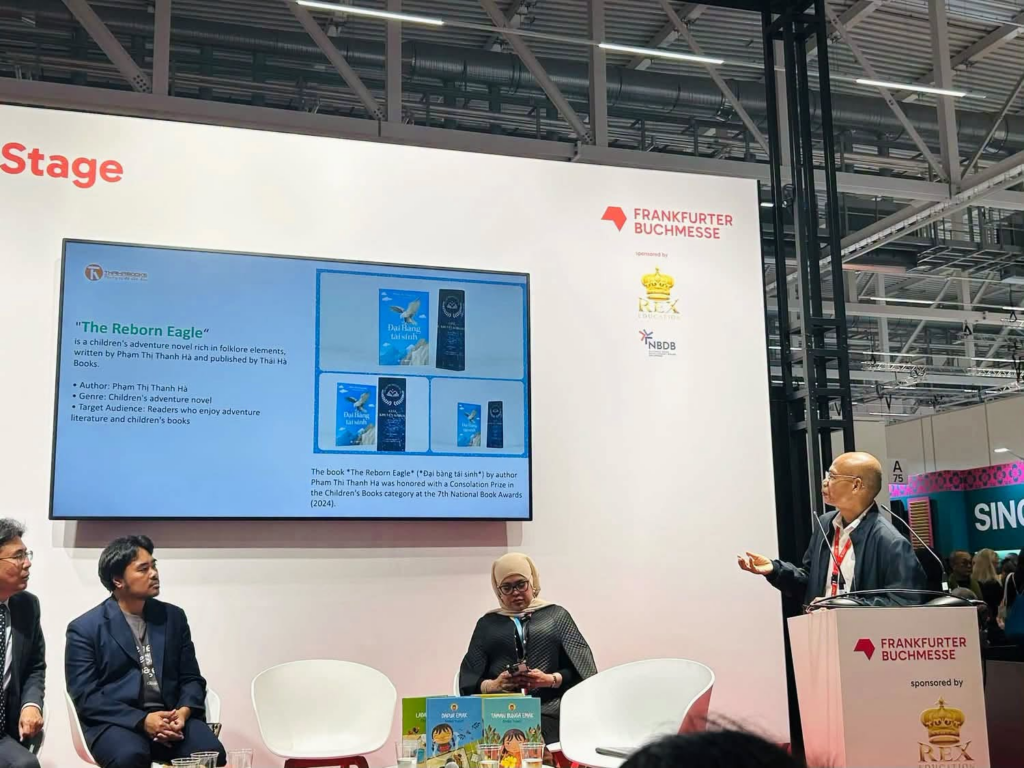
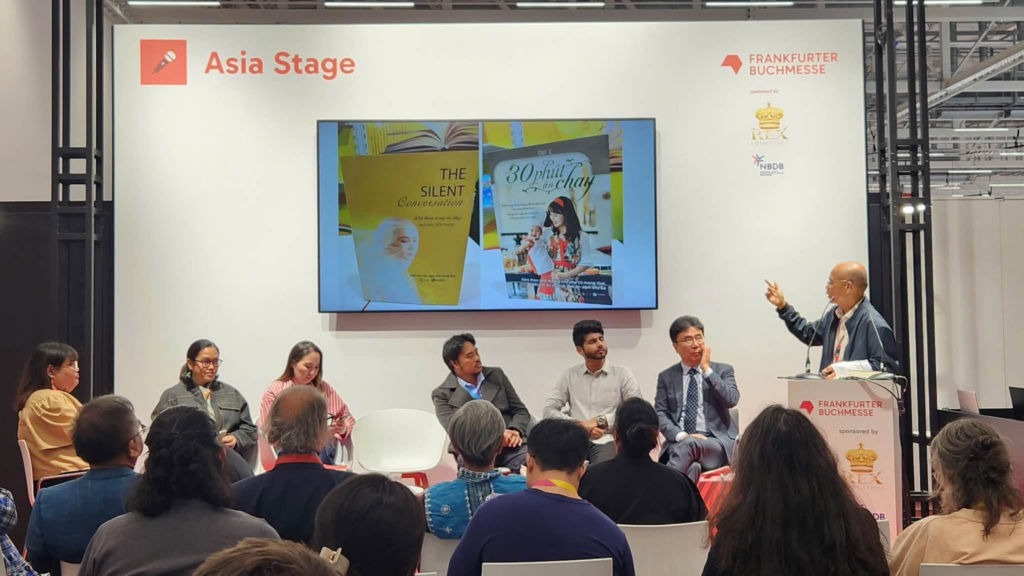
Over many years of attending international book fairs in Frankfurt, London, Bologna, Beijing, Doha, Havana, Istanbul, Kuala Lumpur, Jakarta, Singapore and numerous other places, as well as wandering through the streets of European cities, Dr Nguyen Manh Hung has developed a particular fascination with miniature books. Miniature books are a distinctive form of publishing with a history stretching back many centuries.
During visits to libraries, museums and international book collections, he has always paid special attention to these remarkable little volumes. His own collection includes several exceptional miniature books. Most extraordinary of all is a book described as the smallest in the world, complete with its own passport certifying that distinction.
I placed the tiny book, no larger than the tip of a matchstick, in the palm of my hand. I needed a magnifying glass to read it. The experience was utterly fascinating.
He then began recounting his journeys abroad, when he combined business trips with acting as a guide for friends and colleagues visiting museums and antiquarian bookshops across Europe. One place particularly dear to him is the Gutenberg Museum in Mainz, Germany, the birthplace of Johannes Gutenberg, whose printing technology transformed the course of human history.
I shall never forget the moment I held a book so small that it could only be read through a magnifying glass. I was deeply moved. It was an extraordinary and unfamiliar sensation.
Dr Nguyen Manh Hung took a small sip of tea and reflected that the value of a book does not lie in its physical dimensions. Its true value lies in the ideas it contains. Inspired by this belief, he and Thai Ha Books decided to develop a collection of miniature books imbued with Vietnamese identity. And so the Vietnam: Independence and Self-Reliance collection was born.
Measuring only approximately 3.5 cm by 5 cm, these tiny volumes contain some of Vietnam’s most enduring literary and historical works, including Duong Kach Menh (The Revolutionary Path), the Declaration of Independence, Hich Tuong Si (Proclamation to the Officers) and Binh Ngo Dai Cao (Great Proclamation upon the Pacification of the Ngo).
When he first held these books in his hands, he himself was deeply moved. So was I. Truly moved. They were small enough to fit entirely within the palm of a hand, yet they contained ideas that had helped shape the history of a nation. What made their publication particularly meaningful was the timing: they were released to mark exactly 115 years since President Ho Chi Minh departed to seek a path towards national liberation, on 5 June 1911—115 years before 5 June 2026.
He told us that although these books were tiny enough to rest in the palm of a hand, the values they carried were immeasurably great.
Today, artificial intelligence is transforming the world at an unprecedented pace. Publishing, too, is changing.
Printed books will exist alongside e-books. Audiobooks will continue to grow rapidly. AI will play an increasingly significant role in the production, distribution and accessibility of content. Yet Dr Nguyen Manh Hung believes that one thing will remain unchanged: the human desire to learn and grow.
In his view, the future of publishing is not about producing more books. It is about creating greater value for individuals and society. Special editions honour knowledge and elevate its cultural significance. Pocket books allow knowledge to accompany us through everyday life. Miniature books preserve great ideas and enduring values in a uniquely compact form. Whatever form a book may take, its mission remains the same: to awaken wisdom, nourish the human spirit and contribute to building a learning society.
For Dr Nguyen Manh Hung, it seems that the journey of making books has never been merely a journey of publishing. It has always been a journey of spreading the light of knowledge.
After spending an entire afternoon drinking tea, admiring books and listening to his reflections, I, too, have come to believe that as long as human beings retain their thirst for knowledge, their desire for self-improvement and their aspiration to build a better life, books will always have a place in the human heart.
Tuyet Minh