

[ThaiHaBooks] We might think we know what a book is. It has text, a cover, and a spine. It might also contain images. If it is a reference work, it will likely include a table of contents and an index. Out of habit, we assume books are published, found everywhere in the world, and read by everyone.
But after a moment of reflection on the books in our own homes, or those crammed like sardines on the shelves of some grand historic castle, we realize that many books have never been read.
Yet, whether read, reread, or never opened, books create a sense of familiarity and often bring comfort (or criticism) to our lives. Furthermore, reading specific books at specific times, under specific circumstances, can change lives, broaden minds, terrify, or soothe us.
![[Ấn bản đặc biệt 26] Lịch sử sách](https://product.hstatic.net/200000900535/product/20240610_133231_2c5bf92e3d3a411db6b27a10855b712c_1024x1024.jpg)
WHAT MAKES A BOOK?
There are always challenges to our assumptions of what constitutes a book. If you are reading these lines on paper, in a bound format, you have been drawn into the concept of the codex.
Derived from the Latin word caudex (meaning “trunk” or “block of wood”), a codex is typically defined as a book made of sheets of paper, parchment, papyrus, or similar materials. Although often associated with manuscripts, the term has also become common for printed books in the Western world.
Upon reflection, we might ask: Can a human be a book? Storytellers, teachers, and preachers, past and present, have memorized stories or knowledge to recite or chant upon request. However, most of us would reject the concept of “a human as a book” because of the belief that a book must be a medium containing encoded signs that can be read visually.
ABOUT “THE HISTORY OF THE BOOK”
Books existed even before the “book” as we know it today appeared: that is, many objects and forms carrying writing existed before sheets of paper were bound together to become the default mobile medium for long-term text storage and transmission worldwide.
“The History of the Book” breaks down two barriers to our understanding of books: time and geography. The book takes us around the world, from ancient to modern times, from clay tablets bearing cuneiform traces to electronic tablets displaying digital symbols and images.
Continuous Evolution: The book reveals that books have been continuously modified and reformed over time in various regions.
Comprehensive Insight: Each chapter illuminates the enduring forms of books, key transitional moments, and the long-term coexistence of contrasting uses and materials.
Expert Perspectives: While it may not be exhaustive, with 16 contributors—all leading scholars in their respective fields—the book offers fresh perspectives and a relative understanding of what books have meant and continue to mean in different societies.
Vivid Illustrations: The book features countless illustrations with descriptive captions, offering specific and lively examples of book history.
Summarizing the timeline, “The History of the Book” brings a vivid sense of the unexpected similarities and contrasts in bookmaking and reading history across the globe.
TABLE OF CONTENTS
Chapter 1: Introduction
Chapter 2: The Ancient World
Chapter 3: Byzantium
Chapter 4: Medieval and Early Modern East Asia
Chapter 5: Medieval Western Europe
Chapter 6: The Renaissance and Reformation
Chapter 7: Managing Information
Chapter 8: The Islamic World
Chapter 9: Enlightenment and Revolution
Chapter 10: South Asia
Chapter 11: Industrialization
Chapter 12: Modern China, Japan, and Korea
Chapter 13: Globalization
Chapter 14: The Book Revolutions
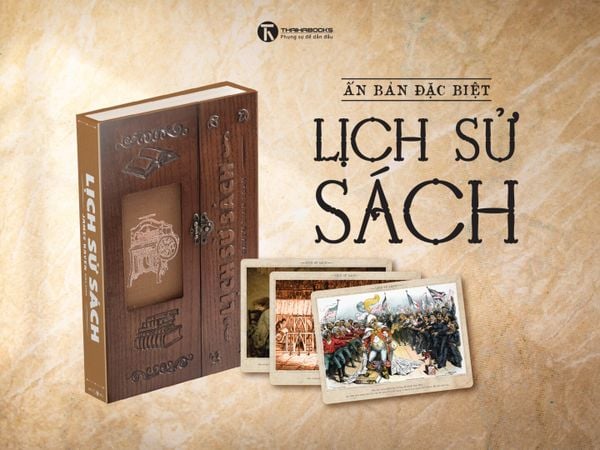
Thai Ha Books developed this special edition based on the concept that books originated from woodblocks, and every book opens up a new horizon. Therefore:
Unique Design: The cover is crafted from oak wood, designed like a door with a functional latch.
Cover Art: The title is embossed, accompanied by the image of a printing press—a significant milestone in the history of the book.
Interior: The 724-page block is printed on Bai Bang cream paper (70gsm), offering a classic look and feel.
Gift Included: A set of 17 color cards printed on Ivory 200 paper, depicting characteristic features and key milestones in the history of the book.
ThaiHaBooks proudly presents!
Book Details:
| Full Title | The History of the Book – Wood-Cover Edition |
| Quantity | Limited Edition of 117 copies |
| Dimensions | |
| Cover Material | Oak Wood |
| Paper Quality | Bai Bang cream paper (70gsm) |
| Price | 2.500.000 VNĐ |
| Publisher | |
| Barcode – ISBN |