Hung Khanh • 16 May 2026
At the forum The Future of the Publishing Industry – Opportunities and Challenges organised by Thai Ha Books in Ho Chi Minh City on the afternoon of 15 May, Claudia Kaiser – Vice President of the Frankfurt Book Fair, the world’s largest book fair – placed Vietnam within the broader context of the global publishing industry, as a market that is increasingly attracting attention and becoming more connected to international activities, rather than merely playing the role of a passive content receiver.
Speaking about publishing trends in the digital era, Kaiser stated that printed books will not be replaced, but technology, especially artificial intelligence, is deeply penetrating the book production process, from editing and translation to content creation. In many countries, AI has already become part of daily workflows, supporting data generation, text processing, and even the translation of simple content. This development places clear pressure on the role of translators, a key link in international publishing. For technical or instructional texts, AI can outperform humans in both speed and cost.
However, Kaiser also pointed out an important limitation: in literature, where language is closely tied to emotion and subtle nuance, AI still cannot replace humans. Word choice, sentence structure, and the ability to convey deeper layers of meaning require experience and sensitivity that machines have yet to achieve. Therefore, while some tasks may be automated, the core values of literary creativity remain dependent on human input. This also places higher demands on editors, who must act as “gatekeepers” to ensure content quality in a context where more works may be generated by AI.
Another notable trend is the return of printed books in a new form. According to observations from the Frankfurt Book Fair, printed books are no longer just a medium for reading but have become cultural products. “Young people are willing to queue for hours to get an author’s signature, turning the act of owning a book into a meaningful personal experience. At the same time, genres such as young adult books, especially for female readers, and visual formats like manga, illustrated books, and infographics are growing strongly. This shows that reading behaviour is not disappearing, but evolving in more diverse forms and experiences,” Kaiser said.
On the other hand, e-books, audiobooks, and podcasts are opening up new spaces for publishing, but their development varies across regions. In the United States and Europe, audiobooks have become a major market with increasing demands for voice quality and listening experience. Meanwhile, in some Asian countries, the habit of paying for digital content is not yet widespread, limiting business models in this area. This difference demonstrates that there is no single formula for digital transformation in publishing; each market must find its own path based on user behaviour.

Alongside opportunities, technology also brings significant challenges. One of the biggest issues Kaiser highlighted is copyright in the age of AI. When content is generated by machines, the question arises: who owns the copyright. Currently, there is no unified global answer, creating a legal gap that could directly affect creative motivation. Without proper copyright protection, the value of intellectual labour is at risk of erosion.
In addition, copyright infringement, already a long-standing issue, continues to burden publishers. In many countries, pirated books remain widespread and significantly cheaper than legitimate editions, causing serious revenue losses. Combined with AI, this risk becomes even greater, as copying and reproducing content becomes easier than ever.
Another fundamental challenge is the increasing competition for readers’ time. In the past, books mainly competed with traditional forms of entertainment. Today, they must compete with streaming platforms, video games, social media, and various online services. As attention spans decline and short-form content consumption rises, the publishing industry must rethink how it approaches readers, not only in terms of content, but also presentation, format, and how to retain attention in a highly fragmented environment.
In this context, the Vice President of the Frankfurt Book Fair emphasised the role of education as a core solution, not only reading skills, but also the ability to use technology, especially AI, responsibly. Publishing professionals must understand the tools they use and recognise the boundaries between support and replacement, creativity and copying. At the same time, readers need to be equipped to distinguish high-quality content from poor-quality or infringing content.
From a policy perspective, Kaiser also highlighted the role of governments in supporting the publishing industry. In many places, publishing has not yet received attention commensurate with its role in building knowledge and cultural foundations.
Another direction she suggested is strengthening connections between publishing and other creative industries, such as film, through adaptations and rights trading. This not only creates additional revenue but also helps expand the reach of books to wider audiences.
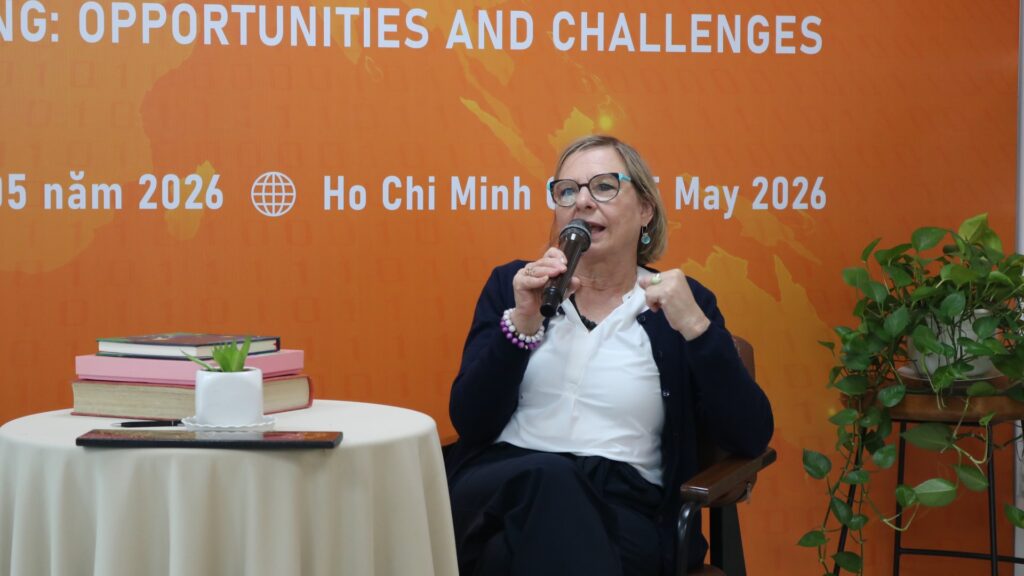
At the international level, Kaiser repeatedly emphasised the need for cooperation and dialogue. Platforms such as the Frankfurt Book Fair and conferences of the International Publishers Association serve as spaces for sharing experiences, learning from one another, and seeking solutions together. According to her, simply “meeting and talking” is a prerequisite for the publishing industry to adapt and grow.
More profoundly, these efforts contribute to a broader goal: enhancing understanding between cultures. Through books and publishing, countries can access each other’s perspectives, thereby reducing misunderstandings and conflicts. Publishing, as Kaiser described it, is not merely an economic sector but also a tool for social and cultural connection.
During the seminar, Kaiser shared that she had just completed a working visit to Hanoi before attending the event in Ho Chi Minh City. Her presence in both major economic and cultural centres underscores the Frankfurt Book Fair’s concrete interest in the Vietnamese market.
Beyond individual activities, a series of Frankfurt Book Fair events taking place across Vietnam over several days indicates that Vietnam is gradually becoming a strategic destination in the fair’s global expansion, rather than merely a passive receiving market.
Previously, the Frankfurt Book Fair had organised activities in Vietnam, including presentations of German book rights to Vietnamese publishers and exhibitions of German works translated into Vietnamese. This direct approach helps connect markets, enabling local publishers to access international content while opening opportunities for two-way cooperation.
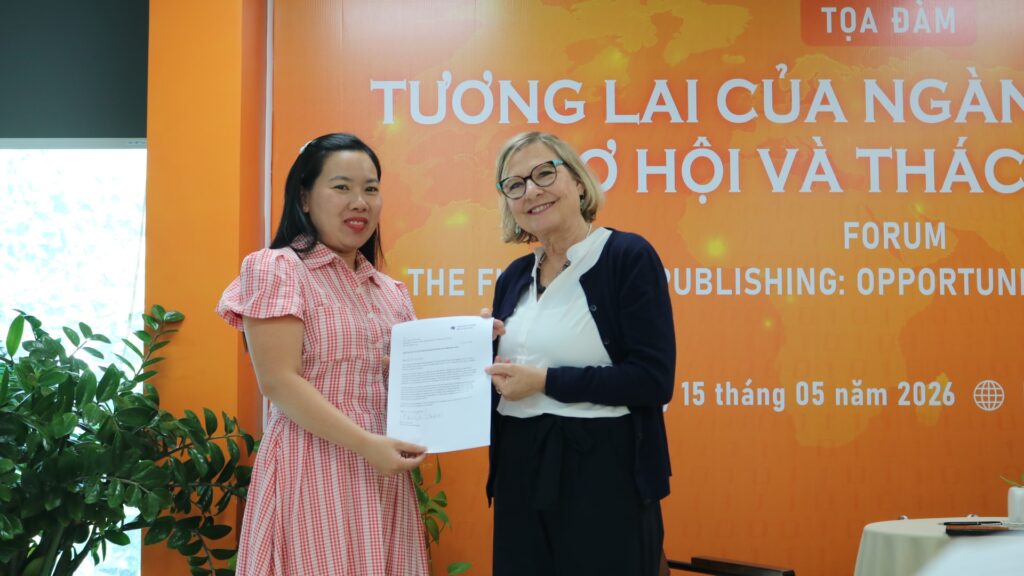
Placing Vietnam within the global publishing landscape, Kaiser noted that to bring Vietnamese books to the world and effectively export rights, Vietnam must begin by building comprehensive databases of authors and works, accompanied by English-language summaries. At the same time, translation support programmes are essential to bring works into international languages. She also emphasised the importance of training professional translators, as language barriers remain one of the main obstacles preventing Vietnamese books from reaching global markets.
In addition, Vietnam should strengthen its presence at international book fairs, especially the Frankfurt Book Fair, by establishing well-designed national stands with clear promotional strategies. Beyond fairs, she suggested that Vietnamese authors should participate in international literary festivals, providing opportunities to connect directly with global readers and publishing communities.
From a content perspective, Kaiser also highlighted themes likely to attract international readers from Vietnam, such as contemporary literature—particularly stories about modern women, family life, and the experiences of young people in modern society. These are universal themes capable of transcending cultural and geographical boundaries.
According to Saigon Entrepreneurs Magazine